
📍 Pinpoint, Explained
A guide to Google's free tool, now open to all

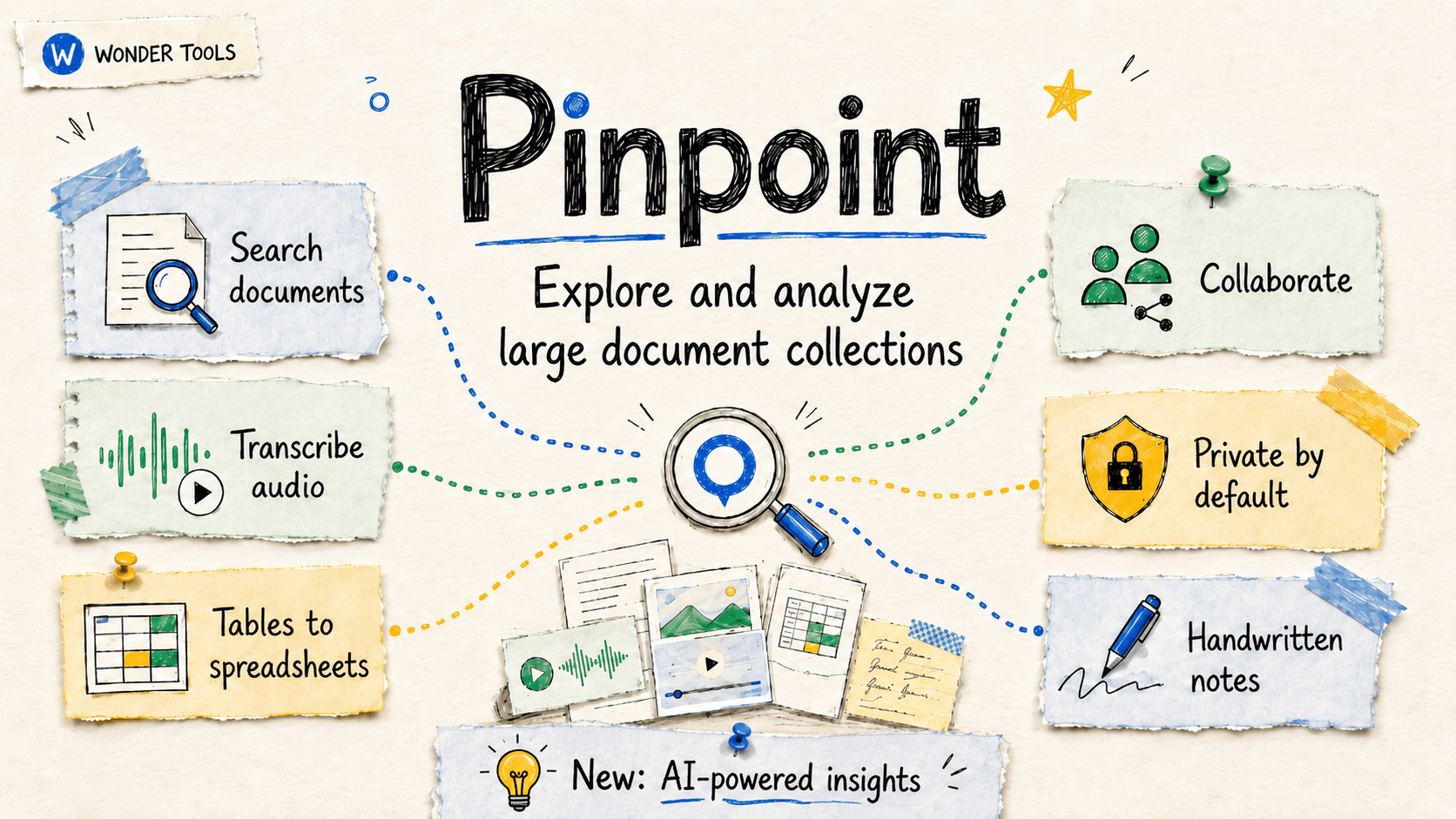
Google’s Pinpoint is now open to everyone. It’s a surprisingly powerful free tool for making sense of giant piles of digital stuff. (Before June 3, it was restricted to journalists and academics). Read on to learn more about creative ways to use Pinpoint; its new AI features and their limitations; and how Pinpoint differs from NotebookLM.
How Pinpoint Works
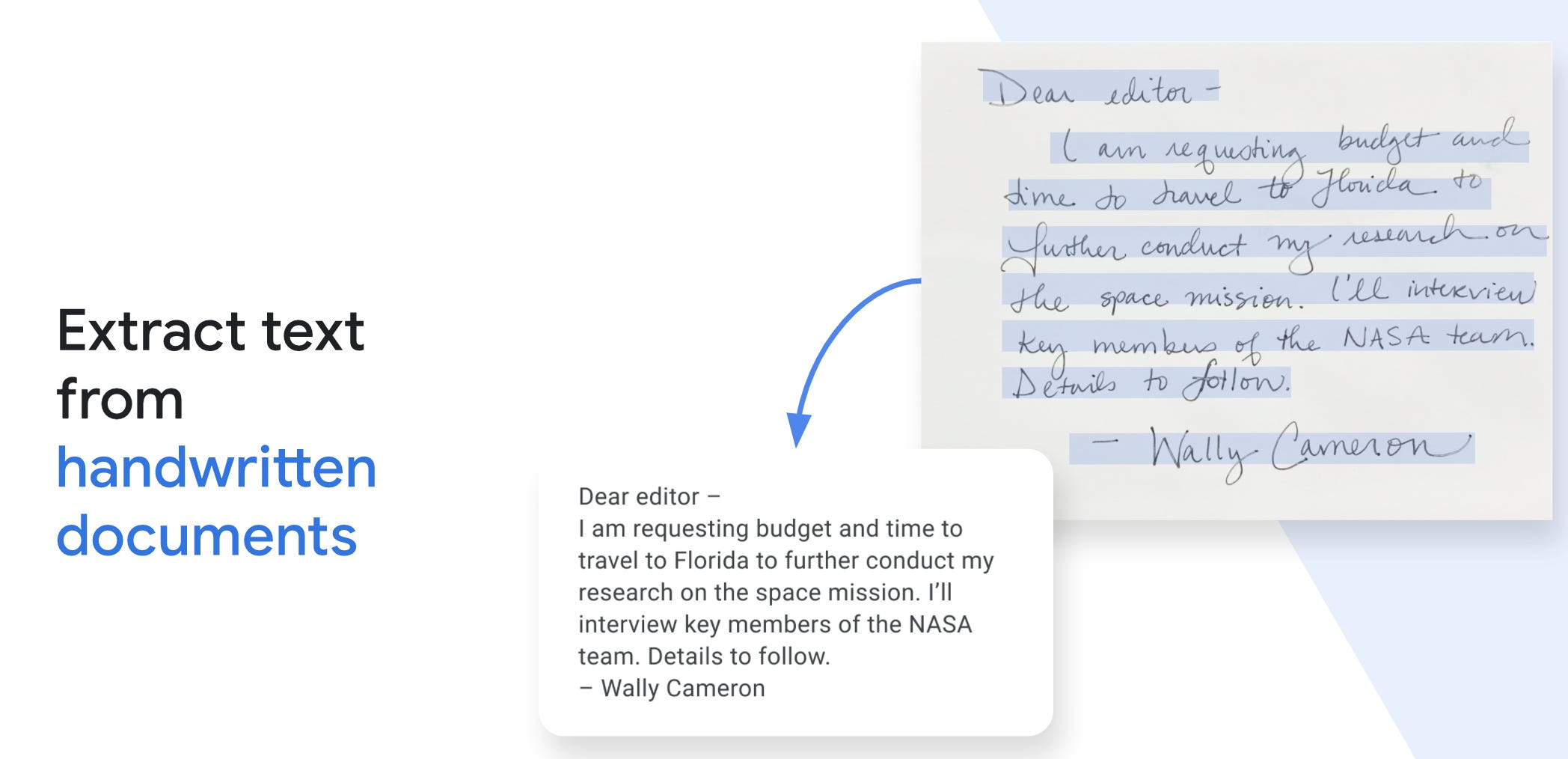
Pinpoint lets you store and analyze hundreds of thousands of files so you can find tiny needles in gigantic digital haystacks.
Pinpoint can transcribe hundreds of hours of audio and video.
It also makes your handwritten text, scans, and PDFs searchable, like my enormous collection of scanned handwritten notes and whiteboards.
Once Pinpoint processes your files you can search, summarize, and organize your collections.
Pinpoint makes it easy to query, label, and extract data from hundreds or thousands of documents. It’s simple to use. No complex menus or commands.
Getting Started
Start by uploading PDFs, emails, audio and video files, handwritten notes, or other file types.
Each collection can have up to 200,000 files. You can have an unlimited number of collections, which function like folders.
Journalists and academics can request “Pinpoint for Professionals,” which provides 100GB of storage. Others start with 1GB.
Audio and video files can be up to 2 hours long and 8GB. The limits are much more generous than what other AI tools, like NotebookLM, offer.
Pro tip: Create separate Pinpoint accounts for each of your Google accounts. That gives you more storage. It’s also how I keep personal projects separate from work. You can always download files you’ve previously uploaded. And request additional storage if you reach your limit.
Pinpoint Features to Try
Scour through audio recordings to locate key moments. Pinpoint transcribes in more than 100 languages. Upload and transcribe your recorded presentations to review how you frame a particular topic. Or how water pollution is described in local council meetings.
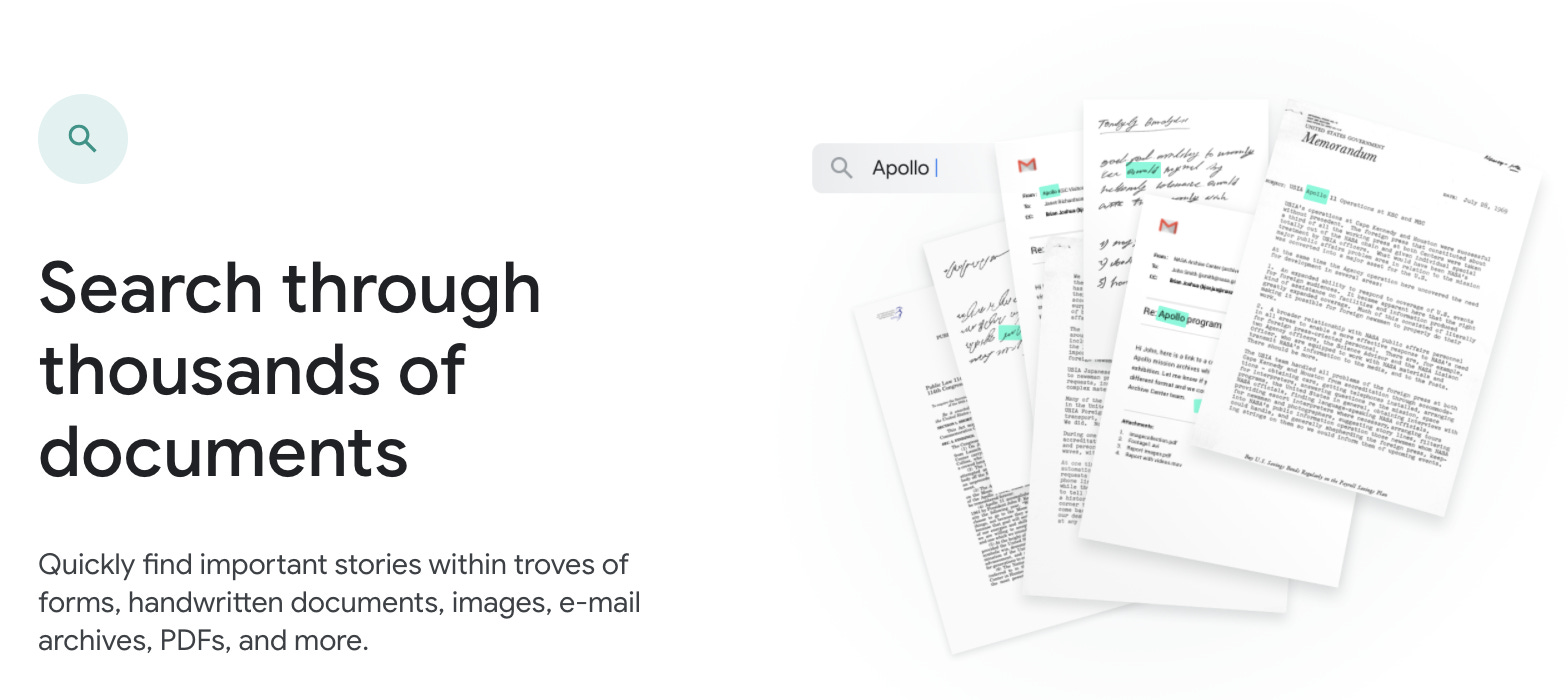
Explore text within images and handwritten notes. I’ve scrutinized my old handwritten notes for ideas and checked whiteboard photos for explanations I can improve.
Share a document collection. Invite individual collaborators or publish a collection for public exploration. Giving readers access to source material can be a valuable form of transparency in journalism.
Analyze an email or document archive. Assess a public email trove or document collection, like files from the Enron trial, for connections between politicians and companies, or financial impropriety.
Focus your research on particular people, organizations, locations, or date ranges. Pinpoint automatically lists a collection’s most frequently-mentioned entities. Click on an entity to jump to exactly where it’s mentioned.
Export important Gmail folders with Google Takeout in .mbox format. Takeout lets you export and back up anything Google hosts. You can then upload your email collection to Pinpoint to find patterns, or locate references to specific people, places, or organizations.
🎁 Try my new Pinpoint Assistant to get personalized ideas for how you can use Pinpoint for a project you’re working on.
Pinpoint in Newsrooms
News organizations have relied on Pinpoint for award-winning investigations involving thousands of documents, including:
Blind Spot by the Boston Globe (Pulitzer)
Poisoned by the Tampa Bay Times (Pulitzer)
Secret Sauce: Expired from North Carolina’s Blue Ridge Public Radio (BPR) (Edward R. Murrow Award).
Z. Waite’s detailed case study explains how and why BPR used Pinpoint. Waite also notes four good, free, alternative tools: DocumentCloud, Datashare, OpenRefine, and Datasette.
Public Collections
Pinpoint’s “Explore” section lets you examine document collections from more than 200 news organizations, ranging from The New York Times and The Washington Post to The Hindu and Süddeutsche Zeitung. Test out the searching and filtering features before uploading anything.
Notable document sets include JFK assassination records, Mueller Court filings, and 80 years of U.S. foreign agent registrations (86,018 documents) uploaded by the Center for Public Integrity.
New AI Capabilities
Pinpoint has a bunch of new AI features in beta available in more than 80 countries. In my testing, not all of the AI capabilities work reliably yet, but you can request early access. Pinpoint’s AI features are designed to help you analyze your files, not generate original content as you might with Gemini or NotebookLM.
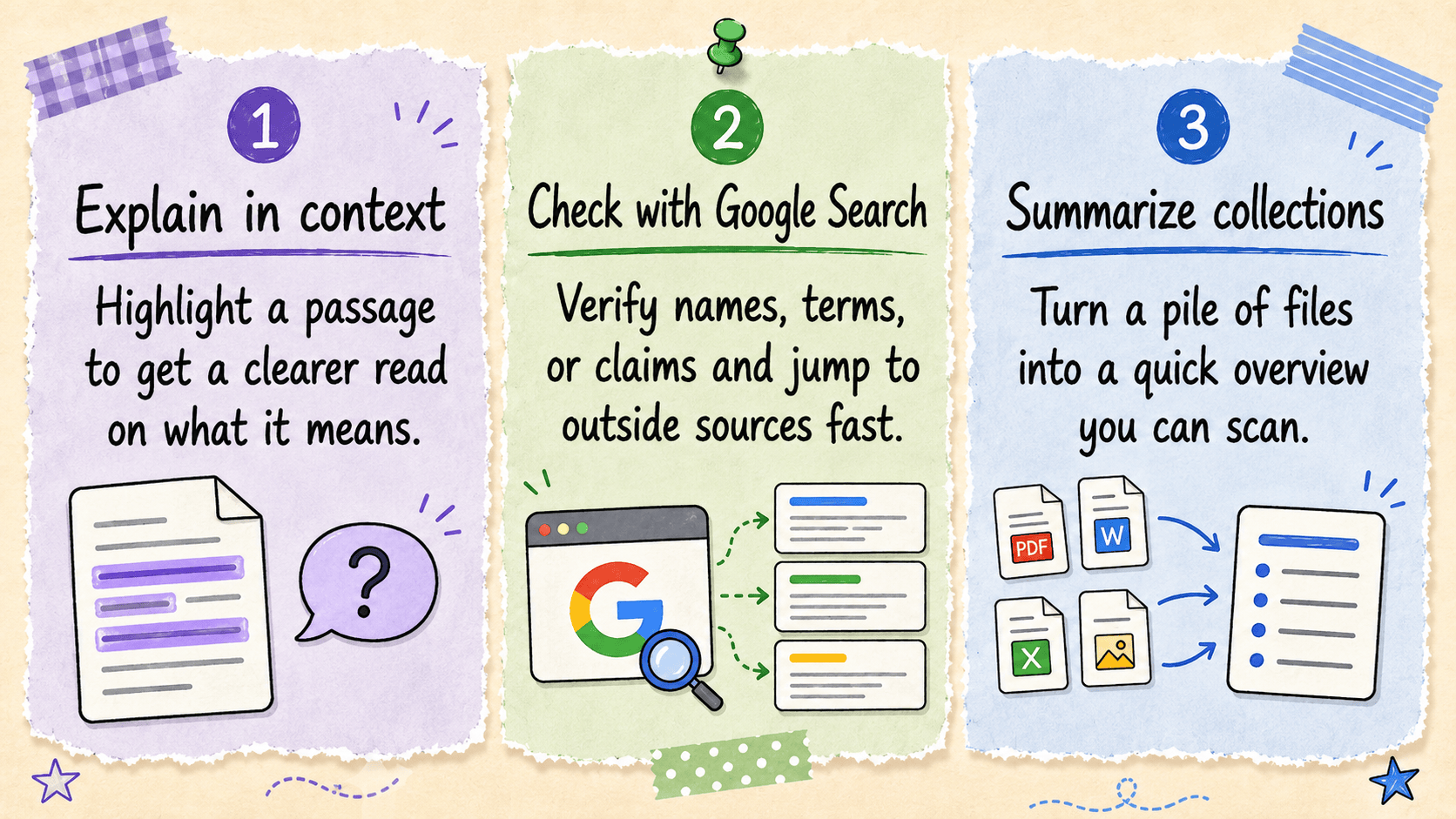
Explain words or phrases in any file. Highlight any text and ask Pinpoint to put it in context. I like the short, useful explanations based on what else is in a document.
Google words or phrases inside your text to learn more from Google. In my tests, this beta feature consistently yields error messages.
Summarize Collections. I like how Pinpoint gives me an AI-generated overview of every file I upload. It can also summarize an entire collection.
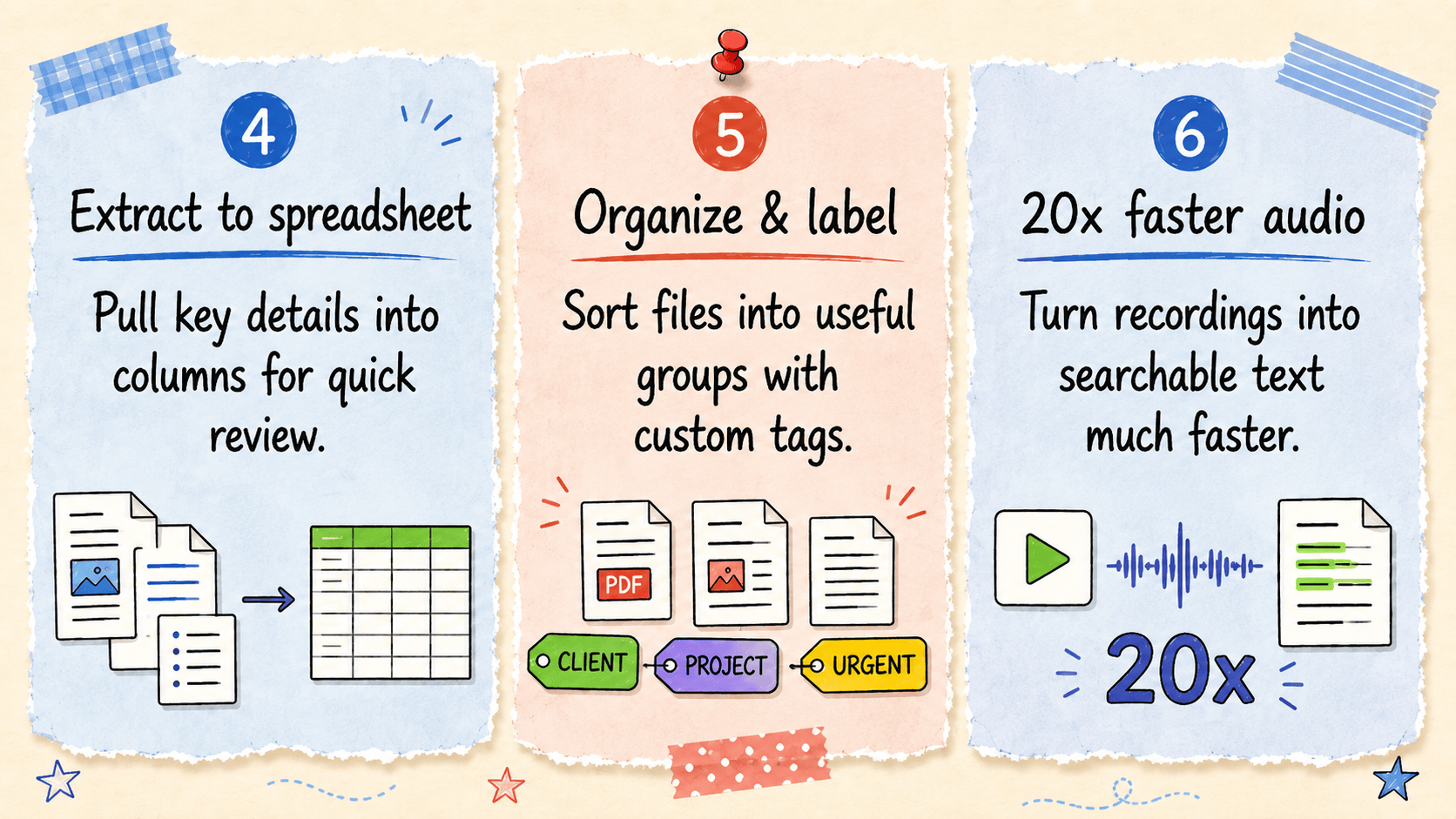
Extract data into spreadsheets. Pull info from up to 100 documents at once and deliver it as a sheet, with links back to the source text for each data point. That’s handy for tracking mentions or doing comparative research. Try this feature for analyzing public government contracts or other information in PDF form that would be easier to work with in a spreadsheet.
Automatically label hundreds of your files in a collection. Let’s say you have a public email dataset. You may want to evaluate just those written by a particular person, or just those discussing a particular stock. Instruct Pinpoint and it will label your collection for you. Limitation: Pinpoint can label 1,000 files at a time. In my tests, the interface only let me select 100 files. If you’re working with tens of thousands of files, labeling may be tedious.
Transcribe audio quickly. Pinpoint now claims to give you high-quality transcribed text 20x faster than it used to. I couldn’t verify that specific metric, but it’s generally fast. Each file is helpfully time-coded. Click on any section of text to hear the corresponding audio. Limitation: unlike Wispr Flow and Letterly, which I use for my personal dictation, Pinpoint sometimes mangles names, and doesn’t learn from its errors.
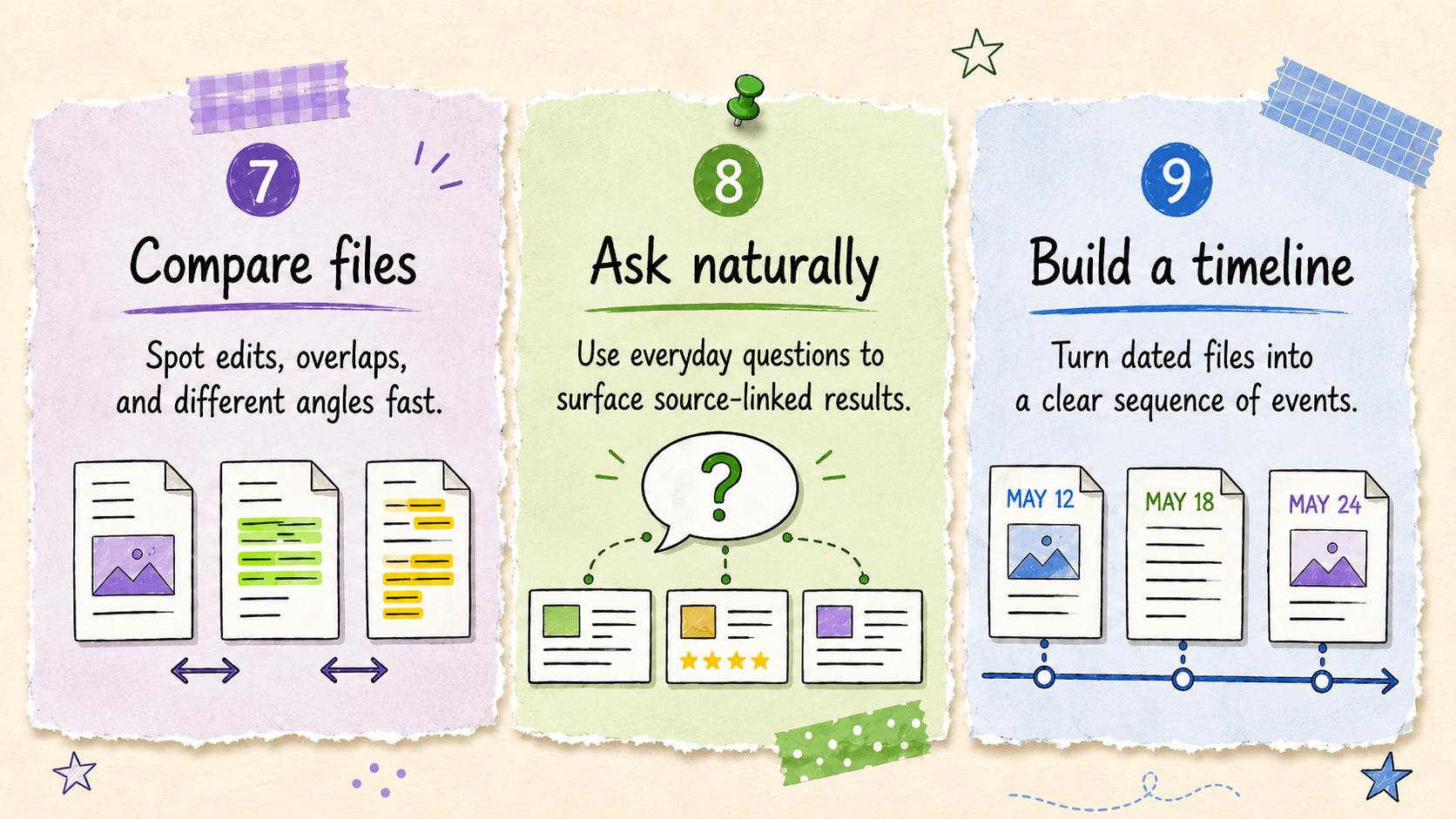
Compare any two or three files. See what changed in multiple versions of a document, or how three different people addressed the same subject.
Query your collection with ordinary language. Results are often fast, useful, and linked back to the original document. Expect occasional errors, though. One search I tried, for example, returned a document mentioning someone with a similar but different name from the one I was searching for.
Create a timeline. If you’re looking at how something developed over time, you can pick up to 100 files and generate a timeline. You can optionally specify a topic for the timeline. This might be useful if your dataset has dated transactions, for example, or multiple reports you want to put in order.
Pinpoint vs NotebookLM
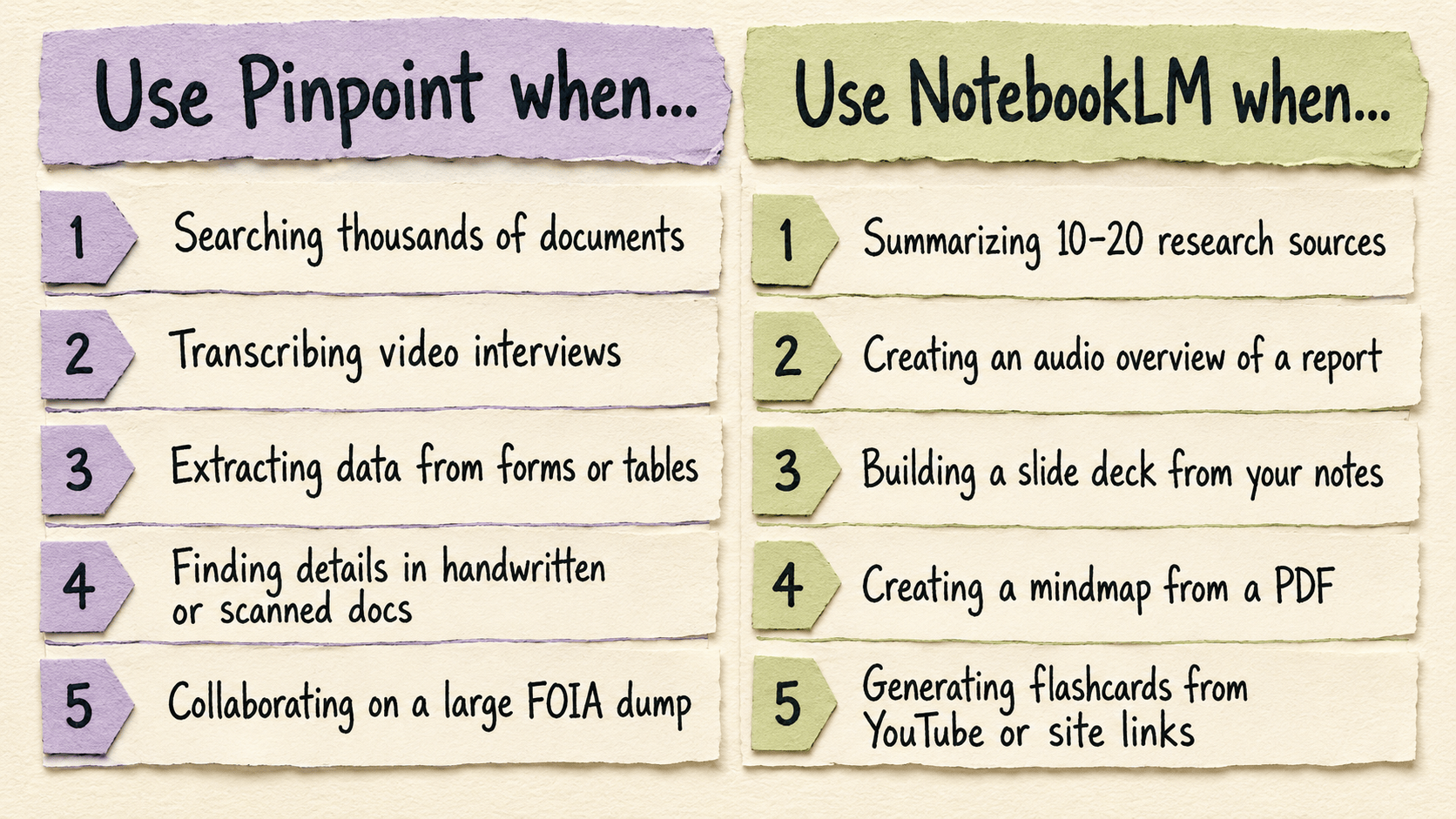
What’s similar: Both NotebookLM and Pinpoint are free Google services that allow you to efficiently summarize and search though large documents.
What’s different: NotebookLM synthesizes and generates (slides, infographics, video and audio podcasts, and reports). Pinpoint, on the other hand, focuses on finding patterns and organizing a wider array of file types in much larger collections of email, multimedia, and scanned images.
NotebookLM allows 50 files per notebook for free users. (See my guide). Pinpoint lets you upload 200,000 files into each collection.
Combine the two: If you have a large collection of documents, consider gathering, storing, organizing, and transcribing in Pinpoint. Then move the most important files into NotebookLM for further analysis and to generate artifacts like reports, slides, infographics, flashcards, audio, and video.
Privacy
Your documents are private. Nothing you upload is public unless you publish a collection. Read Google’s Pinpoint privacy details.
Your files are not used to train AI models. Google explicitly notes that documents you upload won’t be used to train Large Language Models. Read Google’s statement.
The bottom line: I trust Pinpoint for non-sensitive document work. But because uploads are processed on Google’s servers, Pinpoint may not be a fit for everything or everyone. Here are additional privacy details.
Limitations
No mobile app. You can view docs on a phone browser, but not all features work.
No NotebookLM integration yet. You can’t easily move files from one service to the other.
Storage caps. On a 1GB account, you may hit storage limits with large files.
AI features aren’t error free. No AI implementation is.
Wow, this is just what I needed to make sense of my documents! Thank you for your post and podcast note.
Pinpoint is becoming about as central to my work as a spreadsheet is. Great summary here of Pinpoint's features.