




For today’s audio post, I spoke with Nikita Roy, host of the Newsroom Robots podcast, about my favorite ways to use AI. The Q&A below, based on our conversation, addresses commonly-asked questions.

1. What are two useful new ways to use AI?
AI-powered research: Type a detailed search query into Perplexity instead of Google to get a quick, actionable summary response with links to relevant information sources. Read more of my take on why Perplexity is so useful and how to use it.
Notes organization and analysis: Tools like NotebookLM, Claude Projects, and Mem can help you make sense of huge repositories of notes and documents. Query or summarize your own notes and surface novel connections between your ideas.
2. How can AI help me become more productive?
Email efficiency: Shortwave and Superhuman help save time on mundane communication. Their AI-powered search and summarization make it easier to cope with an overflowing inbox. Shortwave is more effective at AI search. Superhuman’s strength: super-speedy shortcuts.
Calendar optimization: Reclaim AI learns your calendar preferences and automates scheduling, helping you prioritize deep work or other unscheduled but important parts of your routine.
Writing enhancement: AI writing assistants like Lex, ButterDocs, and Blaze can spot issues like clichés, suggest edits, and help draft social posts from longer content.
Idea generation: Engage in brainstorming sessions with AI chatbots like ChatGPT, Claude and Gemini. Use them as springboards to explore new angles, consider more creative possibilities, and test new approaches to your work.
3. Beyond efficiency, what are other valuable uses of AI?
AI can go beyond simply speeding up tasks.
Expanding possibilities: AI assistants can push you to explore a wider range of ideas, broadening your horizons.
Uncovering blind spots: Prompt AI to identify potential biases in your writing or blind spots in your project preparation.
Enhancing personal reflection: AI-powered conversational agents can act as sounding boards, helping you process emotions, analyze communication patterns, and consider surprising perspectives on challenges you’re facing.
4. What underappreciated AI tools are consistently useful?

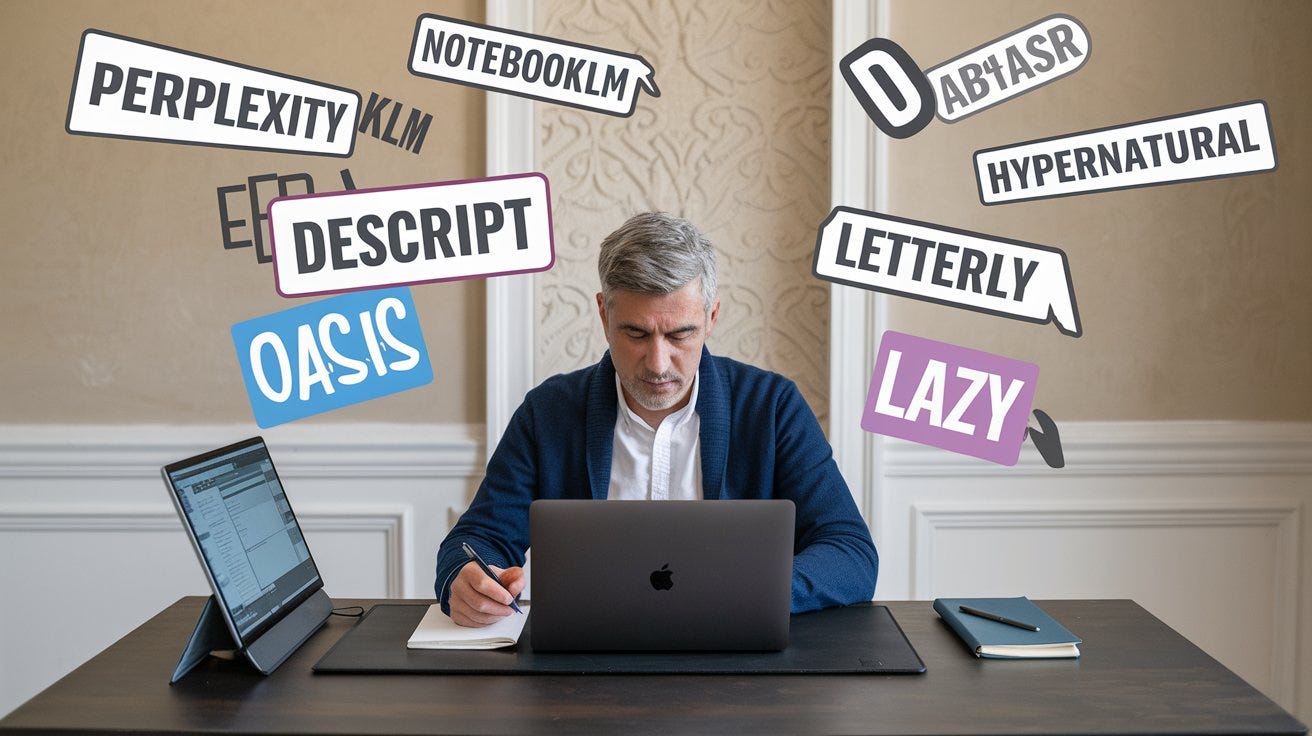
Perplexity: Explore complex subjects efficiently with this AI-powered search engine that provides citations for reliable research. Ideas for using it creatively.
NotebookLM: Apply AI to analyze, summarize and synthesize your collections of notes. Here’s how it works.
Claude Projects: Manage your projects with an AI assistant that learns your style and preferences. Here are several ways to use Claude Projects.
Oasis, Audiopen, and Letterly: Turn rambling thoughts into organized outlines, drafts, and more with one of these AI-powered dictation tools.
Talktastic, Flow: Access AI-powered dictation on your laptop so you can talk instead of typing.
Hypernatural: Convert text and audio into shareable videos, automating a time-consuming process. (I used it to make the video above). Read more about Hypernatural’s best features.
Descript: Edit and publish audio and video easily with this AI-powered multimedia editor. Here’s what I like best about it.
Lazy: Try this AI-enhanced tool to more efficiently capture and save information and ideas.
5. What are the advantages of using local AI models, especially for sensitive journalistic work?
Local AI models—where all processing takes place on your own computer, rather than a network—offer enhanced security and privacy. I’ve tried and like Jan and AnythingLLM. Both are free.
Data protection: All processing occurs on your device, ensuring that sensitive information is not uploaded to external servers.
Offline functionality: These models work without an internet connection, providing accessibility and security even when you’re not online.
Control and transparency: You can choose which open-source AI model to use. And keeping queries off of networks can reduce the risk of data breaches or unauthorized access.
6. How do I choose from the overwhelming number of AI tools?
Pick: Select one tool at a time to try based on a specific need you have.
Stick: Use the chosen tool consistently for a set period to thoroughly evaluate its effectiveness with real-world tasks.
Dig: Explore the tool's capabilities beyond its basic features. Experiment with different uses and make note of limitations. If the tool offers a clear improvement on your old way of doing things, you’ve got a keeper.
7. What caveats should I consider as I dive into AI?
Overdependence: Using AI to replace your thinking can lead to overreliance. Think first. Then use AI to augment your ideas, expanding your capabilities like a crane rather than supporting you like a crutch.
Accuracy and bias: AI models are trained on vast datasets that contain biases. And AI models are notoriously eager to please. When not anchored in documents or data, they occasionally make stuff up, like names of books, people, or events. Critically evaluate AI-generated content by double-checking for accuracy and bias. Test multiple models against one another, and verify information with fact-based sources.
Privacy and transparency: Consider potential future leaks before sharing images, data, or other private information with AI models. When in doubt, be transparent about AI usage.
Ready to learn more about AI?
Join the upcoming Generative AI for Media Professionals live workshop series Nikita Roy and I are hosting in November. We’ll meet weekly to explore the most useful AI. We’ll provide detailed guidance on how to make the most of the best AI platforms and tools. You’ll work on practical mini-projects, immediately applying what you’ve learned.
By the end of four weeks, you’ll be more adept at using AI tools creatively. And you’ll walk away with four mini-projects you can implement in your work as a media professional.
You’ll enjoy the collaborative company of other creative explorers! Each week, you’ll have access to live office hours where Nikita and I will provide personalized support and answer your questions.
For those of you who don’t know Nikita, she’s a star data scientist, data journalist, and host of the Newsroom Robots podcast.
We’re excited to help you make the most of AI. If you’re ready to go from theory to practice and make AI work for you, this is the course for you. 🎓


