
⚡ Gemini, Explained
5 features worth your time

Google’s AI, Gemini, has quickly become one of the AI tools I rely on most. It builds dashboards and creates remarkable infographics. It spins out comprehensive research reports in minutes that would once have taken days to assemble.
It’s improving every month. On March 13, Google announced Ask Maps, so you can query Gemini about things like “Which nearby tennis courts are open with lights so I can play tonight?” On March 10, Gemini added new integrations to build, summarize, and analyze your Google Docs, Sheets, and Slides.
In today’s post below: catch up on the Gemini features worth your time, candid comparisons with other AI tools, and answers to the questions I hear most.
5 Ways to Use Gemini’s Best Features
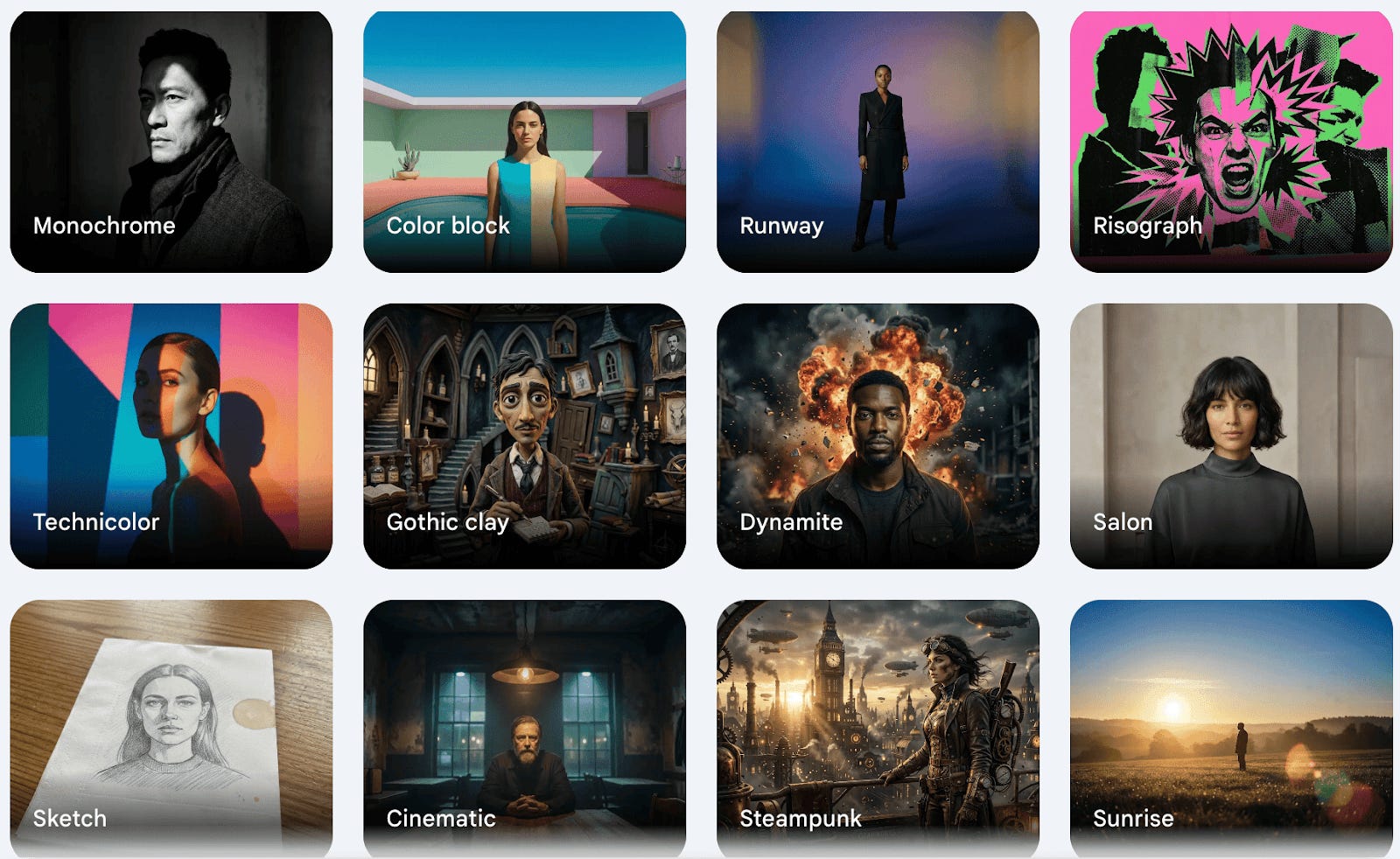
1. Create Images Without Being a Designer
Illustrate a presentation, newsletter post, or handout with a diagram, explanatory image, or an editorial cartoon.
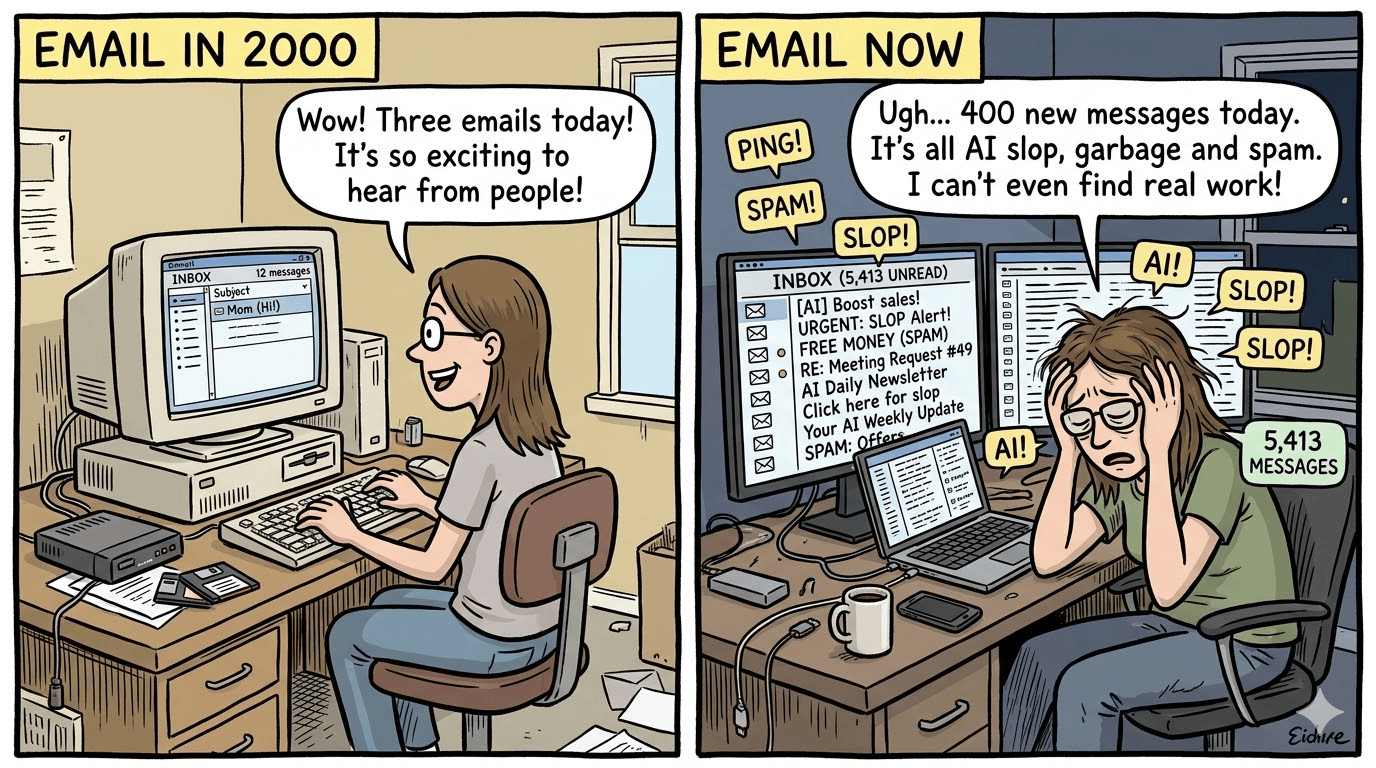
Let’s call it “Vibe Drawing.” Just as vibe coding has enabled people without technical skills to develop useful apps, image generation helps those of us who are artistically challenged to convey ideas visually. I use it to turn raw ideas into graphics, diagrams, illustrations, or cartoons. Here’s a short prompt I used for the image below.
Tip: Upload a screenshot or photograph a paper sketch for Gemini to use as a reference image, or pick a style from the grid of options Gemini shows you (see above) to provide visual context.
2. Get Customized Deep Research Reports
The next time you want to better understand a place, person, event, technology, or organization, pick Gemini’s Deep Research tool and dictate a detailed query.
Tip: Specify why you need the report, how you’ll use it, your level of understanding, preferred sources, specific subtopics, and the angle, tone, or style you like (tables, bullets, diagrams, arguments and counterarguments, etc). You’ll get a remarkably thorough, personalized report. Read my guide to Deep Research, which includes comparisons with other AI research tools.
Examples of Deep Research reports I generated with Gemini
AI Assistant Competitive Analysis 2026 — 20 pages, 53 sources
AI for Medical Diagnostics 41 pages, 95 sources
Michel de Montaigne 29 pages, 89 sources
AI and the Future of Creativity 46 pages, 303 sources
3. Connect Gemini to Your NotebookLM Notes
Gemini now lets you attach a NotebookLM notebook as a source. I tested this with a collection of my writing to probe my past ideas with Gemini. I also used Gemini to query a notebook I curated with PDFs, links, and videos on congestion pricing.
Combining Gemini and NotebookLM offers several advantages:
Gemini has access to the Web, so it can supplement references in a notebook with new research material, whereas NotebookLM is grounded only in your source materials. The combo is great when you want to query a mix of curated and new sources, but NotebookLM alone is preferable when you want to fully constrain your exploration to your own notes.
NotebookLM can create audio and video overviews, infographics, and compelling slides from your materials. (Read more in my guide). But Gemini has even more tools it can apply to your notebooks, like Canvas for making apps, interactive graphics, and sites.
You can query multiple notebooks at the same time with Gemini, something you can’t yet do with NotebookLM.
Note: Gemini has a context window of 1 million tokens, which means it can absorb and consider about 1,500 pages of text for any given query.
4. Build Gems to Automate Repetitive Tasks
Gems are versions of Gemini with custom instructions. Create a Gemini Gem as a template for work you’ll do many times. Start by uploading reference documents and adding detailed guidance. If relevant, set it to always use a particular tool, like deep research, image generation, or Canvas for building interactive tools.
Example: I like making Jeopardy-style games for teaching, so I set up a Gem that lets me quickly create new editions for specific topics. I was inspired by Eric Curts’s free collection of more than 100 EduGems, which he lets anyone adapt.
Create other Gems to…
Check your work for bias or blind spots. To start, upload style guides, fact-checking instructions, or your pet peeves. Direct the Gem to be a tough critic rather than a sycophantic bootlicker. Instruct it to be specific and clear in its feedback.
Create analytics reports in a specific format. Start by giving the Gem instructions and context. Then tell it to pull from data you add to a NotebookLM notebook, or feed your Gem new sheets or data screenshots anytime you want a new report. The Gem could even be set up to turn your data into an interactive dashboard if you instruct it to use its Canvas tool for coding.
Generate alt-text, SEO text, invoices, or expense reports. Start by giving the Gem your preferences or policies, then open it anytime you want to take care of a technical task.
Gemini Gem Alternatives
Other AI platforms offer similar customization tools:
ChatGPT: Create Custom GPTs either privately or to share with colleagues.
Claude: Create Skills for Claude, teaching it a specific way to analyze or design something. Or set up Projects with detailed instructions and knowledge files. Read my guide to Claude Projects.
Perplexity: create Spaces with instructions and reference files.
5. Build an App, Game, or Interactive Tool
Gemini can generate code, just as it can make text or images. Select the Canvas tool and describe a site, game, tool, dashboard, or interactive infographic you want to make.
Ideas and examples
Build a custom flashcard app. How? Give it a PDF with 100 Japanese vocabulary words.
Get strategic recommendations with an interactive dashboard. Give it your metrics output, and make sure it’s in Thinking mode.
Get help memorizing poems. How? Share a list of your favorites and ask for a spaced repetition game to help with memorization.
Practice sign language phrases. Tell it what you know or don’t know and how you prefer to practice. Or upload a selfie video and request feedback.You can also use Gemini’s Guided Learning mode for this. Read my guide to AI as a tutor.
Gemini vs. Other AI Tools
Gemini beats Claude on versatility
Gemini can generate images, videos, and songs — and analyze video content— none of which Claude does.
… but I prefer Claude’s editing suggestions
I regularly rely on its Projects feature. Claude also has useful integrations with many other services I use, like Granola, so I can query my meeting notes. Gemini doesn’t yet have extensive integrations.
Gemini beats ChatGPT in integrating NotebookLM
I love being able to query an entire notebook full of lengthy YouTube videos, audio files, links, and notes.
… but ChatGPT has a wider range of Custom GPTs,
ChatGPT also has built-in apps that let you design with Canva, Figma, or other tools, which you can’t do with Gemini.
Gemini has the deepest integration with Docs, Sheets, and Slides
The newest features let you create a complete dashboard in Google Sheets from data in Google Drive, generate editable slides that match the style of a presentation, and match the format of existing docs.
… but Claude, ChatGPT, and Copilot also work well with Google Drive
You can pull in content from Google Drive regardless of which AI tool you use. And Claude Code and Cowork have unique capabilities. They act as AI agents that independently manage sequences of tasks.
Gemini Basics
1. Add Files for Context
Upload up to 10 files to provide context for any prompt. For example, if you’re asking for help summarizing your organization’s policies for a new colleague, you can upload thousands of pages worth of rules and regulations.
Most files can be up to 100MB in size. Videos can be 2GB and up to 5 minutes long. Audio files can be 10 minutes long. With Gemini’s video analysis, you can even ask for input on your public speaking or knitting technique if you record yourself.
Pro tip: You can reference dozens of files, links, or videos by choosing NotebookLM and using an entire notebook as context for your prompt.
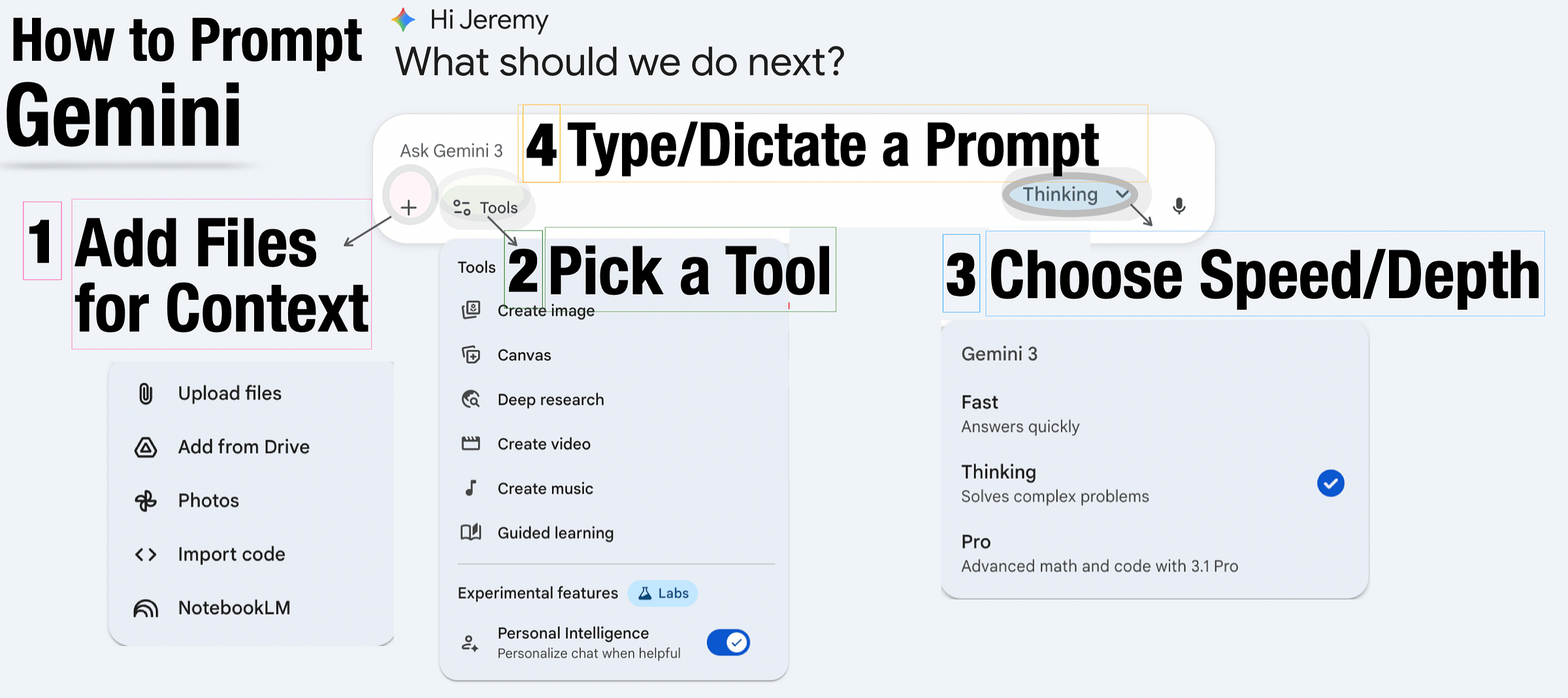
To make the most of Gemini, upload contextual files and choose Thinking mode for richer responses. Use Tools to generate visuals & interactives, and use your voice to dictate detailed prompts.
2. Pick a Tool
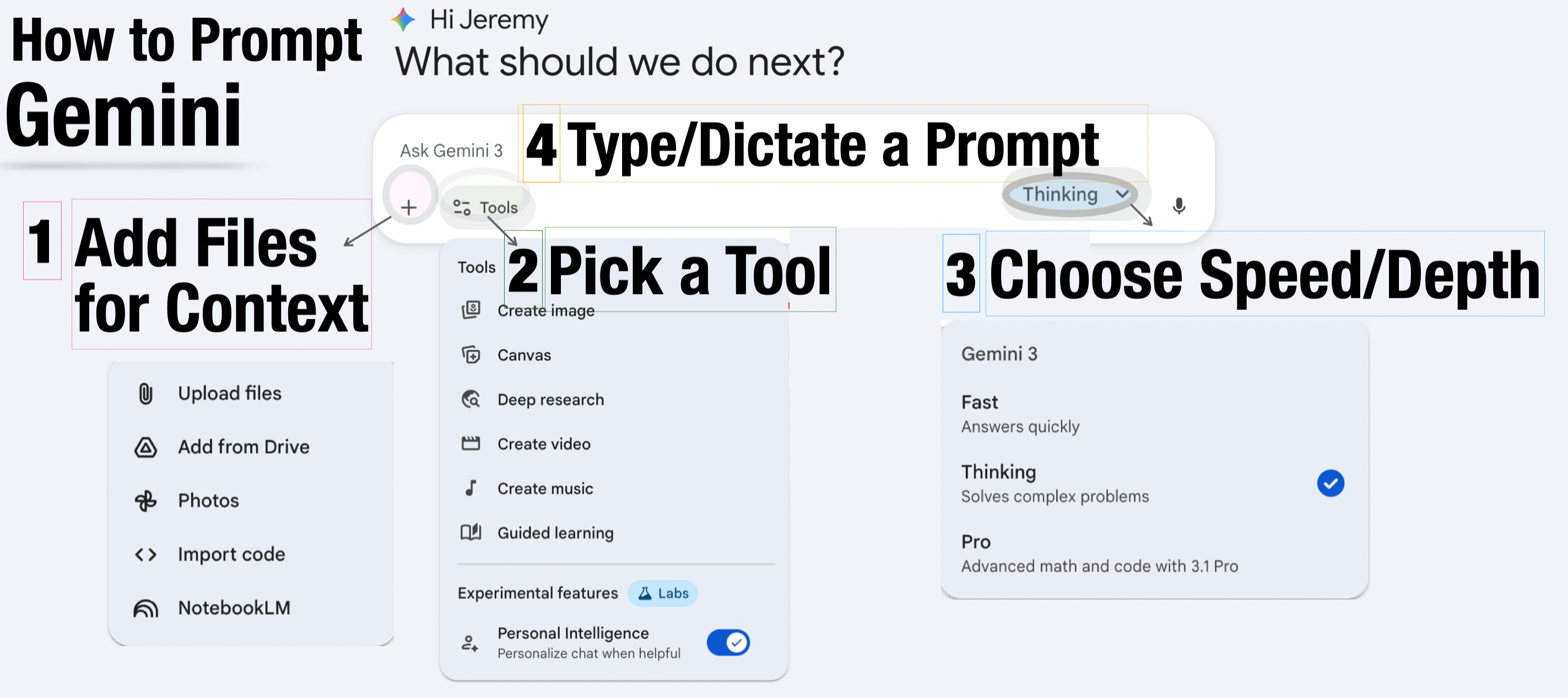
To generate something other than a text response, pick from Gemini’s tool menu. It will create an image, dashboard, visual explanation, 20-page research report, 8-second video, or 30-second song.
If you opt into Google Labs, you can also turn on Personal Intelligence as a Gemini tool setting. That allows Gemini to customize responses based on other aspects of your Google account, like your Drive or Gmail.
3. Choose Speed or Depth
Choose between Fast mode for quick responses, Thinking mode for deeper reasoning, or Pro mode if you’re doing deep analysis on a coding problem or a 300-page PDF. Pro mode is limited on free plans.
My tip: Use Thinking mode as much as possible, for high-quality responses. Choose Fast mode only for simple requests, like alternative words for generosity.
4. Dictate, Type or Paste Your Prompt
Include a detailed prompt that specifies what you’re working on, what your goal is, and how you plan to use Gemini’s response. For example:
“Generate a detailed summary of our company travel policies based on these 5 attached documents. Include the key country-specific details as a table. I’ll use this to supplement an onboarding resource for new colleagues I’m developing, so keep it concise.”
Use voice dictation as often as you can. Click on Gemini’s mic button to use your voice. You’ll see the words appear on screen as you dictate, so you can correct or edit anything before submitting your query. Alternatively, use an external tool like Flow, the app I use to dictate in any app.
Many of us can speak 3 to 6 times faster than we type. We also edit our words less when we speak. So using your voice often results in more detailed prompts, which yield better responses.
Voice dictation isn’t the same as Gemini Live, a conversational mode where you chat back and forth, similar to ChatGPT’s Advanced Voice Mode. That mode is useful for practicing a foreign language, simulating an interview, or rehearsing for a difficult conversation. Read more on why I rely on Voice AI.
Brief Answers to Gemini Questions
Q: Is Gemini free? A: Yes, with limits. Basic features are free, but some advanced capabilities, like video generation, require a subscription of ~$20/month.
Q: Which AI should I use — Gemini, Claude, or ChatGPT? A: Tough one. My short answer, as of today: Use Gemini for image generation and Google Workspace integration; Claude when you want to give your AI assistant special skills, writing styles, or deep project context; and ChatGPT for the widest range of third-party apps. I’ve found all three to be consistently helpful AI assistants.
Q: How is using Gemini different from using Google.com? A: Googling gets you links. Gemini creates content, builds tools, and reasons through problems. Gemini is a work assistant while Google is a search tool. I find Gemini’s Deep Research to be much more valuable than a typical Google search, and I often search Perplexity when I want to understand a complex issue. (Here’s why).
Q: Can Gemini access my Google Drive files? A: Yes, if you opt in, it can analyze data in your sheets, update slides, summarize your email, or create a dashboard based on files in your Drive.
Q: Is what I share with Gemini totally private? A: Not necessarily. If you’re on a Google Workspace paid plan, Google’s Privacy Hub says your content isn’t reviewed by humans or used to train AI models. If you’re on a free plan, or even a personal paid plan, Google may use your data to improve its services. Check the privacy overview for details on how Gemini handles your data.
Q: What can I do about privacy? A: Take Gemini’s privacy page seriously when it says “please don’t enter confidential information that you wouldn’t want a reviewer to see or Google to use to improve our services.” Visit your Apps Activity Page to check and adjust your data retention settings.
If you’re deeply concerned, consider private AI services. Jan and Msty, for example, work offline, without sending any data away of your computer to external servers. Here’s how you can use AI privately for free on your laptop, without a complicated setup.
I find myself going to Gemini over others because of being so integrated into the google environment already. I think this integration of tools where you already are is key to any of these platforms success
I opted for the $20 version of Gemini partly because it includes an upgraded version of NotebookLM and it includes additional storage I was already paying $10 for in Google World, thus a net cost for Gemini Pro of only $10. By the way, I prefer the blue you use for dropcaps and other accents and Gemini provided me with clear guidance to go blue on howtrue.substack.com. Big thanks all around!